Showing posts with label World War II. Show all posts

07 December, 2021

07 December, 1941

Well, if you’ve been paying attention the last few days, you knew this was coming.

TORA! TORA! TORA!

And with those words, the attack begins.

“A day that will live in infamy!”

maxresdefault

07 | December | 2008 | Today's History Lesson (wordpress.com)

At just a few minutes before 8:00 am, the guns on the Japanese fighters started blazing and the bombs and torpedoes started falling.

Ninety minutes later, after two separate waves of attacks, it was over…for both sides.

As far as the U.S. was concerned, it was a huge disaster.  Yamamoto’s goal of tactical surprise was perfectly executed.  The various groups of planes arrived over their targets with almost surgical precision (if air attacks can be assessed that way), making it nearly impossible for the U.S. soldiers to focus on one target.  What’s more, the Japanese had off-loaded handful of midget submarines early on the 7th.  At least one had been discovered and sunk several hours before the attacks began, but still no serious alarms were raised.  As the smoke rose over Oahu, five battleships rested on Pearl’s harbor floor, three cruisers were damaged or sunk, and three destroyers were damaged or sunk, along with a handful of other ships.  More than 300 aircraft had been wrecked or damaged, and 2,400 people had taken their last breaths, with another 1,300 wounded.

FDR’s remarks:

The commander in charge of the attack, Admiral Yamamoto is alleged to have said afterwards:

"I fear all we have done is to awaken a sleeping giant and fill him with a terrible resolve."

I highly recommend the movie I referenced earlier, as well.

06 December, 2021

06 December, 1941

The Japanese Fleet lead by Admiral Yamamoto abord the Akagi (pictured above) is almost to Pearl Harbor and America has completely misread Hirohito’s intentions.

FDR to Japanese emperor: "Prevent further death and destruction" – HISTORY

President Roosevelt—convinced on the basis of intelligence reports that the Japanese fleet is headed for Thailand, not the United States—telegrams Emperor Hirohito with the request that “for the sake of humanity,” the emperor intervene “to prevent further death and destruction in the world.”

The Royal Australian Air Force had sighted Japanese escorts, cruisers, and destroyers on patrol near the Malayan coast, south of Cape Cambodia. An Aussie pilot managed to radio that it looked as if the Japanese warships were headed for Thailand—just before he was shot down by the Japanese. Back in England, Prime Minister Churchill called a meeting of his chiefs of staff to discuss the crisis. While reports were coming in describing Thailand as the Japanese destination, they began to question whether it could have been a diversion. British intelligence had intercepted the Japanese code “Raffles,” a warning to the Japanese fleet to be on alert—but for what?

It was a bluff.

Meanwhile, 600 miles northwest of Hawaii, Admiral Yamamoto, commander of the Japanese fleet, announced to his men: “The rise or fall of the empire depends upon this battle. Everyone will do his duty with utmost efforts.” Thailand was, in fact, a bluff.

05 December, 2021

05 December, 1941

The Kido Butai  is approaching Pearl Harbor!

The Kido Butai has been making it’s way toward it’s December 7th destination: Pearl Harbor.

So far it has been quietly making its way across the Pacific. The U.S. is apparently unaware of the fleet.

That all became at risk on this day in 1941.

Why? Because a Russian trawler got in the way and almost screwed up everything.

A fleet of this size is nearly impossible to hide, but Nagumo somehow managed…until December 5, 1941, when they ran smack-dab into the Russian transport trawler Uritsky.  Instantly, the intrigue began to build.  Russia was at war with Japan’s ally, Germany, but Russia was not in open conflict with Japan, thanks in part to the Tripartite Pact, which allowed Japan to maintain its non-aggression pact with Russia.  Furthermore, Japan wasn’t really interested in open war with the Soviets…they were on there way to Hawai’i to try and stifle an open war with the United States.

There’s more.  Some have said (though I’m not sure it’s been proven) that the Uritsky notified Russian officials of the Kido Butai (roughly translated as “Mobile Force”), who then quickly told the Japanese that allowing a certain transport to continue floating would insure that nobody, particularly the United States, was informed of a certain carrier force moving east.

But it wasn’t just about protecting a transport carrying a few tanks.  Joseph Stalin had good reason to keep quiet about the fleet, too.  He was in a desperate situation with the Germans (as we saw just yesterday), and military moves he was making (which we’ll discuss shortly) meant he really didn’t want a war with Japan, which would tie up troops in the Far East.  What’s more, while Stalin was a pretty good guesser, it didn’t take a scientist to see that the Kido Butai heading east pretty much meant one thing:  Pearl Harbor.  So Stalin bet that an attack was coming…an attack that would bring America into the war, which he really did want.

So Nagumo allowed the Uritsky to continue unmolested to its destination:  Vladivostok.  And the Russians apparently kept quiet, too, as the Kido Butai closed in on sleepy Sunday morning Oahu.

TL;DR – Rumor: The Russians knew about the attack on Pearl Harbor and did nothing. Two days later, the U.S. Navy would suffer for the Russian silence.

03 December, 2021

02 December, 1941

Climb Mount Niitaka.

The stage is set for war. Japan is going to war with the United States. In 5 days.

(actually 6, because at the time the fleet was on the other side of the International Date Line)

So on December 2, 1941, the coded message, Niitakayama Nobore (“Climb Mount Niitaka“), arrived on Nagumo’s flagship.  The Admiral then opened a set of top secret documents which confirmed that Japan would be going to war with the United States, Britain, and Holland.  It also gave a date for the opening of hostilities…December 8th (the 7th on the Pearl Harbor side of the International Date Line).

niitakayama-y

30 November, 2021

30 November, 1993

Schindler’s List released. I haven’t watched that movie in forever. I should watch it again.

schindlers-list-17523-hd-wallpapers

Schindler's List is a 1993 American epic historical drama film directed and produced by Steven Spielberg and written by Steven Zaillian. It is based on the 1982 historical fiction novel Schindler's Ark by Australian novelist Thomas Keneally. The film follows Oskar Schindler, a German industrialist who saved more than a thousand mostly Polish-Jewish refugees from the Holocaust by employing them in his factories during World War II. It stars Liam Neeson as Schindler, Ralph Fiennes as SS officer Amon Göth and Ben Kingsley as Schindler's Jewish accountant Itzhak Stern.

26 November, 2021

26 November, 1941

A rare double “On This Day” post for me. But I’m going to be hitting Pearl Harbor pretty hard over the next two weeks, and this is where it kind of officially begins.

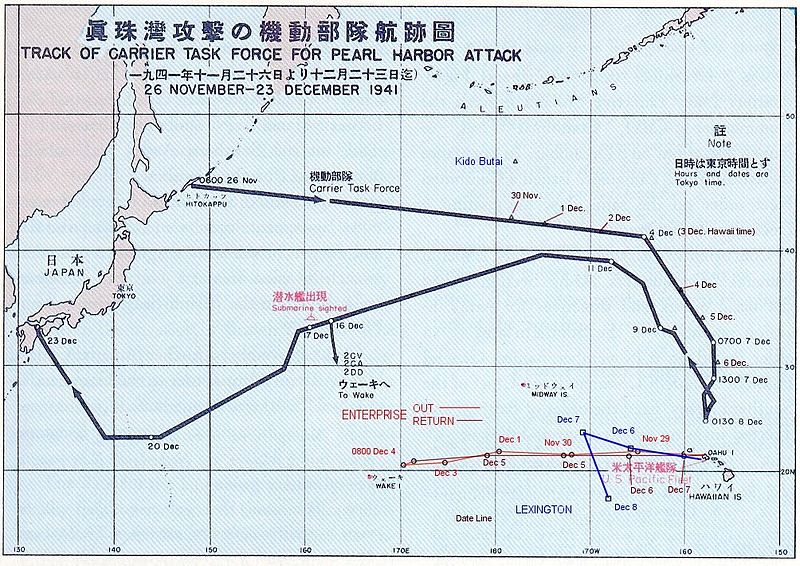
The Kidō Butai  sets sail for Pearl Harbor, it’s exact destination still under sealed orders.

The Kidō Butai (機動部隊, "Mobile Unit/Force") was the Combined Fleet's tactical designation for its combined carrier battle groups.[15] The title was used as a term of convenience; it was not a formal name for the organization. It consisted of Japan's six largest carriers, carrying the 1st Air Fleet.

File:PearlHarborCarrierChart.jpg

Thus began the first phase of the planned attack on Pearl Harbor.

On November 26, 1941, a Japanese task force (the Striking Force) of six aircraft carriers—Akagi, Kaga, Sōryū, Hiryū, Shōkaku, and Zuikaku—departed Hittokapu Bay on Kasatka (now Iterup) Island in the Kuril Islands, en route to a position northwest of Hawaii, intending to launch its 408 aircraft to attack Pearl Harbor: 360 for the two attack waves and 48 on defensive combat air patrol (CAP), including nine fighters from the first wave.

20 November, 2021

20 November, 1945

The Nuremberg Trials begin.

Hermann Goering on trial at the Nuremberg Trials. He would later be sentenced to death, but committed suicide the night before his sentence was to be carried out.

At the end of World War II in Europe, the victorious Allied powers created the first international court to try war criminals from Nazi Germany. Headquartered in the German city of Nuremberg, the first and most famous trials of the major war criminals were held between November 20, 1945 and October 1, 1946, with verdicts announced on September 30 and October 1.
In the end, a large number of senior Nazi leaders were sentenced to death, including Hermann Goering (who killed himself with cyanide the night before his sentence was to be carried out), Karl Dönitz, Martin Bormann (who was missing but sentenced to death in abstentia), Alfred Jodl, Joachim von Ribbentrop and various others. Some leaders, like Rudolf Hess and Albert Speer, were given prison terms in Spandau Prison. The death sentences were carried out on October 16, 1946.
Described as "the greatest trial in history" by one of the presiding judges, Nuremberg was a leap in international law, and would set a precedent for trying war crimes in an international court. The effect of Nuremberg can be seen in the modern-day International Criminal Court and with the prosecution of criminals for actions during wars in Yugoslavia and beyond.

20 October, 2021

20 October, 1944

General MacArthur returns to the Philippines.

"I came through and I shall return," those were the famous words announced by General Douglas MacArthur on March 20, 1942, as he arrived in Australia, following an audacious escape from Japanese-occupied Philippines. Their island in the Philippines - which had been an American territory until the Japanese occupation - had been surrounded by the Japanese. MacArthur's defense and escape captured the imagination of Americans back home and he became a symbol of resistance.
His escape from near certain capture was welcomed by most, though Joseph Goebbels named him the "fleeing general" and Benito Mussolini called him a coward. Nevertheless MacArthur promised to return, and after being awarded the Medal of Honor was put in charge of all American activities in the South West Pacific.
Over the next two years, bitter fighting would allow MacArthur's promise to come true. On October 20, 1944 MacArthur waded ashore in Leyte after his troops had invaded and secured a beachhead. He then declared triumphantly: "People of the Philippines: I have returned."

13 February, 2021

And Now Winston Churchill Isn’t Good Enough—For Brits!

Cambridge University Panel: Winston Churchill A “White Supremacist” Leading Empire “Worse Than The Nazis” (infowars.com)

A Cambridge University panel of academics discussing wartime Prime Minister Winston Churchill’s legacy concluded that the leader who helped defeat Hitler was actually a “white supremacist” and was leading an empire “worse than the Nazis”.

Well, isn’t that nice?

Churchill had his faults, as did the British Empire, which is one reason the British Empire doesn’t really exist anymore. But worse than Nazis? I don’t think you can back up such a statement. I dare you to say it in front of a Jew.

Another academic, Dr Madhusree Mukerjee, dismissed Britain’s role in the Second World War, stating that “It was the Soviets who defeated the Nazis and the Americans who defeated the Japanese.”

Ok, I admit my knowledge of British military campaigns in  WWII is not the best, but I don’t think you can back that up.

What destroyed the Germans in WWII was having to fight a two front war. Hitler could have wiped out the Soviets if he didn’t have to worry about covering his back. Now some of that was the Americans. Ok, a lot of it was the Americans. But you have to give the Brits credit for not succumbing and keeping fighting long enough for the Americans to join the War and get a foothold in it. Remember, Great Britain was the first real obstacle that Hitler faced. His Blitzkrieg maneuvers totally rolled over the rest of Europe. If he’d been as successful against Great Britain, the War would have turned out much differently. I’m not even sure how the Americans can help all that much in the European Theater without the aid of Great Britain.

There were other things that Great Britain did. They were instrumental in the Tunisia Campaign and in defeating Italy, thus pretty much eliminating the southern front (I don’t know if anyone actually calls it that—that’s my moniker) as an issue.

Also, they kept the shipping lanes somewhat open, although it was the American B-24 that really turned the tide (no pun) in the Atlantic. They provided air bases for the combined British and American bombing campaigns in France and Germany. Again, the War in Europe would not have been won without this.

Finally, the Brits more than held up their end in Operation Overlord (D-Day), which began the final offensive against Hitler’s Germany.

So, while they may not have done much against Japan (although even against Japan their contribution was greater than zero—see Madagascar), victory in Europe would have been impossible without Churchill and the Brits.

Implying or stating otherwise is to be completely ignorant of WWII history. I know I don’t know all that much, but I know enough to realize how ludicrous such a belief actually is.

04 February, 2021

February 4, 1945

The Yalta Conference.

Churchill, Roosevelt and Stalin meet to decide how to divide up Germany after the war.

The Yalta Conference, also known as the Crimea Conference and code-named Argonaut, held February 4–11, 1945, was the World War II meeting of the heads of government of the United States, the United Kingdom, and the Soviet Union to discuss the postwar reorganization of Germany and Europe. The three states were represented by President Franklin D. Roosevelt, Prime Minister Winston Churchill, and Premier Joseph Stalin, respectively. The conference was held near Yalta in Crimea, Soviet Union, within the Livadia, Yusupov, and Vorontsov Palaces.

24 April, 2012

What If the Unthinkable Happens?

A little different post from me today. Few numbers, just speculation about a possible result of having high government debt and ignoring our national resources.

I’ve pointed out endlessly the issues relating to the economic crisis in Europe. I’ve also mentioned the ongoing situation in the Middle East more than once. And I’ve discussed our own debt and who owns it constantly. The point I’m trying to make here is that there are high tension areas all over the world. And it’s not getting better. I haven’t even mentioned Korea, or Russia.

This kind of world wide tension is what led to both World Wars.

So, what if the unthinkable happens? What if there’s a protracted, conventional, World War? I won’t go completely unthinkable and discuss nuclear options. I’m just talking about conventional warfare with ships, planes, tanks and lots of young men (and women).

Can the United States win such a war? I don’t want to say that I’d bet against us. Americans have a long history of fighting hardest when our backs are against the wall. And we have an incredible military with the best trained soldiers and the best military minds in the world.

But the odds would definitely be stacked against us.

We certainly don’t seem to have the patience for a four year effort like WWI and WWII. Remember, after two weeks of the War in Iraq, the press was already using the word “quagmire”. It was such a huge issue in the 2004 Presidential race that the Democrats nominated an anti-war hero.

Conventional wars cost a lot of money. How will the United States finance the war effort? The countries that have been buying most of our debt are the countries we’re most likely to be at war with. We’d have to sell war bonds. But we’d still have to finance our existing debt. Which would mean more bonds. And we have a weakened economy. Who’s going to be able to buy the bonds?

What about natural resources? How are we going to power our ships and planes? The countries that have been selling us most of our oil are also the countries we’re most likely to be at war with. We’re not drilling enough here or refining enough here to do it on our own. And it would take money and time to get that infrastructure going again, particularly the refineries.

And it’s not just oil. Building refineries, ships, planes, weapons requires lots of steel. Steel production in the United States is barely a quarter of what it was in 1973. How long would it take to get steel production back up to the levels we’d need for a protracted war? And how much would that cost?

Could we win? I honestly don’t know.

Fortunately, there’s little to no chance of the unthinkable happening, right?

Right?

06 June, 2011

June 6, 1944

D-Day. The storming of the beaches at Normandy. The first part of the Allied invasion of German controlled Europe in WWII. Four sentences without verbs.

You know, we Americans like to think that when it comes to the big things, that we always do the right thing. It might take us a while, but we get there, and when we do, we make up for our slowness with the kind of fierce pride and determination shown at Normandy.

But, I have to wonder, would our current President give the approval for such an invasion? I honestly don’t know that he would. Does that say more about me than him? Is it because I’ve totally lost confidence in his ability to do anything right, or because it’s actually true?

Hopefully we’ll never have to learn the answer to such a question.

UPDATE: General Eisenhower’s D-Day speech: